

Faith, Science and Action Unite for the Planet
 BlueLink 07-10-2025.

Academic and civic voices in Bulgaria explore how religion can inspire climate responsibility
Divine justice reveals itself through the very environmental disasters and ecological crises that threaten humanity with devastation. Many social injustices—poverty, hunger, forced migration, and the reckless use of material goods—are causes or consequences of ecological disruption and natural disasters.
This is how Assoc. Prof. Kostadin Nushev of Sofia University “St. Kliment Ohridski” framed the link between religion and the urgent climate challenges Bulgaria has once again faced in recent days. That connection set the tone for a candid, lively discussion during an academic-practicioner conference at the Rectorate of Sofia University. BlueLink, the Civic Think-and-Action Network, and the University’s Faculty of Theology held the event on 7 October 2025 under the title “Climate Change and Religion: Reflection and Interaction,” as part of activities of the Climate Coalition – Bulgaria and the European Climate Pact.
Protecting nature: our moral duty
Chair of the National Assembly’s Committee on Environment Mladen Shishkov described the conference as a bridge—between knowledge and faith, science and spirituality, public policy and personal responsibility (pictured right). “We live in a time when climate change is no longer a forecast; it is reality,” he said, extending condolences to the families of those who lost their lives in the recent disaster and asking God to forgive them. Shishkov stated:
“We are witnessing floods, fires, drought, air pollution, and loss of biodiversity! All these phenomena remind us that we have no right to be indifferent. Science gives us knowledge, but religion gives us meaning. Science offers solutions, and faith inspires us to apply them. Because protecting nature is not only a technical task—it is a moral duty.”
Opening the conference on behalf of Sofia University, Assoc. Prof. Dr. Svetoslav Ribolov—Deputy Dean of the Faculty of Theology and Associate Professor of Patrology (the study of the early Christian “Fathers”) — added: the Church safeguards creation. The major debate soon will not be between creationism and evolutionism, but to what extent humans are responsible for preserving the creation entrusted to them by God, and whether sin itself leads to the ecological crisis.

“Our efforts to strengthen the civic movement for climate rights—and to counter polarization, mistrust, and the refusal of dialogue so typical of our time—led us to conceive this conference,” explained Dr. Pavel Antonov, BlueLink’s Executive Editor (pictured left). “Environmentalists and people of faith share values and goals: to protect creation from sinful human greed—whether we name it God’s creation or Mother Nature.” The strong interest in the topic and the depth of the presentations, he added, require continued work to connect religion with overcoming the climate and environmental crisis and its consequences.
Dr. Zlatina Karavalcheva of the Dveri Foundation (second from left) noted that environmentalism and religious worldviews are too often set in needless opposition. Citing ancient and contemporary Christian sources, she highlighted the direct relationship between human behavior and the environment we inhabit. “Abusing the divine order—through destruction and greed—disrupts all of creation, which responds with revolt: disasters, cataclysms, manifestations of a world out of harmony with humanity because humanity is out of harmony with God and with itself,” Karavalcheva said. Overcoming the ecological crisis cannot come from economics and science alone; it also requires moral transformation of the human heart, she concluded.
Greed must be replaced by gratitude for all that we have been given as our common home, and indifference by care, said Fr. Ventsislav Nikolov of the Cardinal Stefan Wyszyński University in Warsaw (second from right). He presented the Catholic Church’s ecological movement that grew from the papal encyclical Laudato Si’. In his paper “Ten Years of Laudato Si’: A Spiritual Path to Safeguard Our Common Home,” he stressed that humanity has forgotten to live as the gardener of Eden, misreading the command in Genesis to “have dominion over the earth.” Ivan Koutzaroff, analyst and project lead at BlueLink, presented the practical dimensions of Laudato Si’ in believers’ lives.
Spirituality against wastefulness

Metropolitan Naum of Ruse (pictured center) called on scholars, clergy, policymakers, and citizens alike to adopt a grateful and ascetic ethos that limits waste and encourages shared responsibility. “Today climate change reveals the deep connection between ecology and social justice. Pollution and destruction always weigh most heavily on the poor and vulnerable. Therefore every care for the environment is also care for human dignity,” he said.
For his decades of leadership asserting that “ecological justice is inseparable from social justice,” and that caring for creation is bound up with Christian ethos and the spiritual life of the Church, the Ecumenical Patriarch was recently awarded the Templeton Prize in the United States. Patriarch Bartholomew’s book reminds us that nature is an “open book” through which we discern God’s grandeur, Metropolitan Naum explained. “When we relate to the world with attention and gratitude, we perceive the earth not as an object for exploitation, but as a gift and a mystery. That is why the Church speaks of a ‘cosmic liturgy,’ in which humanity is called to be a faithful steward, not a ruthless master of creation,” said the senior hierarch and member of the Holy Synod of the Bulgarian Orthodox Church.
The question of preserving God’s creation is not alien to contemporary people; on the contrary—it touches the core of our spiritual and public life, Metropolitan Naum added. He offered greetings and blessings to the conference and presented the Bulgarian edition of Ecumenical Patriarch Bartholomew’s book Encountering the Mystery, published by the Ruse Metropolitanate. Sharing personal observations from the Patriarch’s “Religion, Science and Environment” floating symposia and their profound impact was Bruce Clark, journalist at The Economist and a long-time participant (pictured on screen). Antonov, himself a former participant in some of the symposia, reflected on lessons learned that are applicable to today’s public and communication landscape around climate and nature protection.

10 years after Laudato Si’
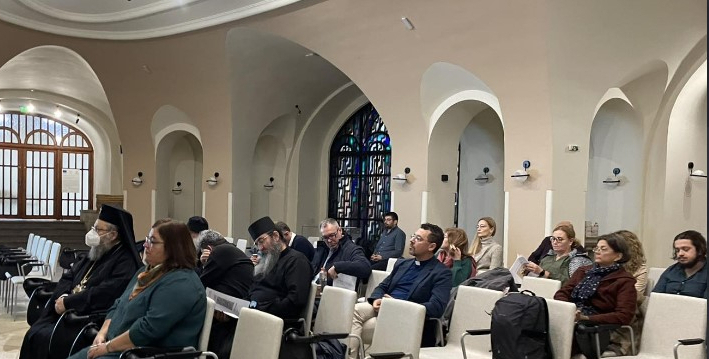
Held in the space of Sofia University’s former chapel, the conference paid special attention to the tenth anniversary of Laudato Si’, by which the late Pope Francis mobilised the Catholic world to address climate change. Pope Francis calls on us to protect creation, care for every living being, and live with reverence toward nature, Shishkov recalled. “At the heart of Pope Bergoglio’s reasoning is the view that Western society—even with the participation of many faithful Christians—has misinterpreted the biblical story of creation,” the Committee Chair said.
“Let us not forget: the climate crisis is also a spiritual crisis. It reveals our greed, our lack of moderation, our disregard for future generations. And this is where religion can inspire change—teaching gratitude instead of insatiability, compassion instead of indifference, sharing instead of isolation,” addressed participants Robert Jerassi, Deputy Chairman of the Supreme Israelite Spiritual Council and Co-chair of the National Council of Religious Communities.
Dželal Faik, Secretary-General of Bulgaria’s Chief Muftiate, also expressed support for the conference “Climate Change: Reflections and Interaction.” Journalist Georgi Milkov, host of the weekly BNT programme “Religion Today,” shared observations from North Africa and the Middle East, showing how drought and desertification expose local communities to hunger and religious radicalisation. Dr. Petar Gramatikov offered examples of dialogue on nature and climate among religious leaders of major traditions (Christianity, Islam, Buddhism, Judaism, Hinduism).
Different prayers for a shared climate
More than 30 participants and lecturers— theologians, lawyers, experts, journalists, doctoral candidates, and students—presented diverse aspects of the contemporary ecological agenda around climate change and responsibility for creation, in line with the Church’s living tradition. Papers explored the links between Christian ethics and ecological values; the biblical foundations of human responsibility for creation (Gen. 2:15); and Orthodox ascetic and prayer practices that form ecological consciousness in the spirit of the Church and its liturgical life.
Dr. Plamen Peev, BlueLink’s lead legal expert, outlined connections between faith and climate rights. Participants shared practical experience of how churches and religious movements contribute to ecological social justice, and how social and natural disasters often intertwine.
Assoc. Prof. Nushev pointed to the many examples—forest fires, hurricanes and floods, destruction and conflict, migration flows and ethnic tensions—directly linked with global warming and climate change. In many of these ecological and social calamities, he said, we can recognise God’s justice and the wisdom of Christ’s Gospel, which sounds ever more insistently as a warning to contemporary humanity: “He [the wise man] is like a man building a house, who dug deep and laid the foundation on the rock. When a flood came, the torrent struck that house but could not shake it, because it was well built.” (Luke 6:48)
Further reading
Full final programme of the conference and list of participants can be downloaded here (in Bulgarian).
Conference invitation “Climate Change: Reflections and Interaction” – here (in Bulgarian).
Theologians and ecologists discuss climate, faith, and human responsibility at Sofia University. Dveri Foundation, 08.10.2025 (in Bulgarian)
For queries, partnership, or proposals, please contact the organisers here.
More information about BlueLink’s “Climate Change and Religion” initiative can be found here.
BlueLink implements this event with co-funding from the European Climate Foundation and the EU’s LIFE Programme. ECF and the European Commission are not responsible for the content and the views expressed.


