

For Civic Participation in Climate Decision-Making Through Science and a Safer Internet
 BlueLink 24-11-2026.
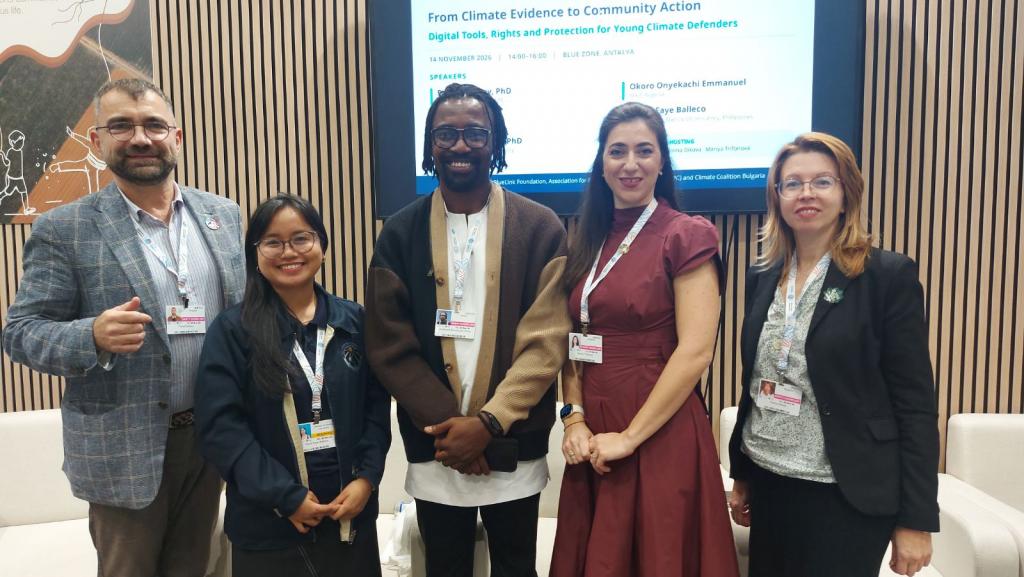
How can scientific evidence and digital technologies help people influence climate decisions without being excluded, intimidated or silenced? This question brought together scientists, civil society organisations and environmental defenders from Bulgaria, Nigeria and the Philippines on 14 November 2026 at the Bulgarian Pavilion of the COP31 UN Climate Change Conference in Antalya, Türkiye.
The international discussion, "From Climate Evidence to Community Action: Digital Tools, Rights and Protection for Young Climate Defenders", was organised by BlueLink – the network for civic thinking and action – and the international Association for Progressive Communications (APC). BlueLink held the event also as a supporting member of the Climate Coalition Bulgaria and a partner of the European Climate Pact, connecting its work on climate rights, civic participation and digital protection with the European community for climate action.
Participants addressed three interconnected challenges: how scientific knowledge can reach affected communities, how citizens and young people can meaningfully participate in decision-making, and how those demanding environmental justice and institutional accountability can be protected.
Climate damage calls for scientific evidence and public accountability
Climate change is already causing serious and unevenly distributed damage to public health, nature and the Bulgarian economy. This was emphasised by Assoc. Prof. Dr. Mariya Trifonova of Net-Zero Lab at Sofia University "St. Kliment Ohridski", who presented findings from the joint national scientific assessment of climate vulnerabilities and impacts. According to the data she presented, 3,414 deaths in 2024 were associated with heat exposure, with older people and women disproportionately affected. Direct economic losses caused by drought and heat in 2025 exceeded EUR 1 billion.
Trifonova also highlighted the gap between accumulated scientific knowledge and its practical application by public institutions. Among the problems identified were the absence of a national climate damage registry, insufficient integration of climate risks into public budget planning, and limited access to reliable information at the local level.
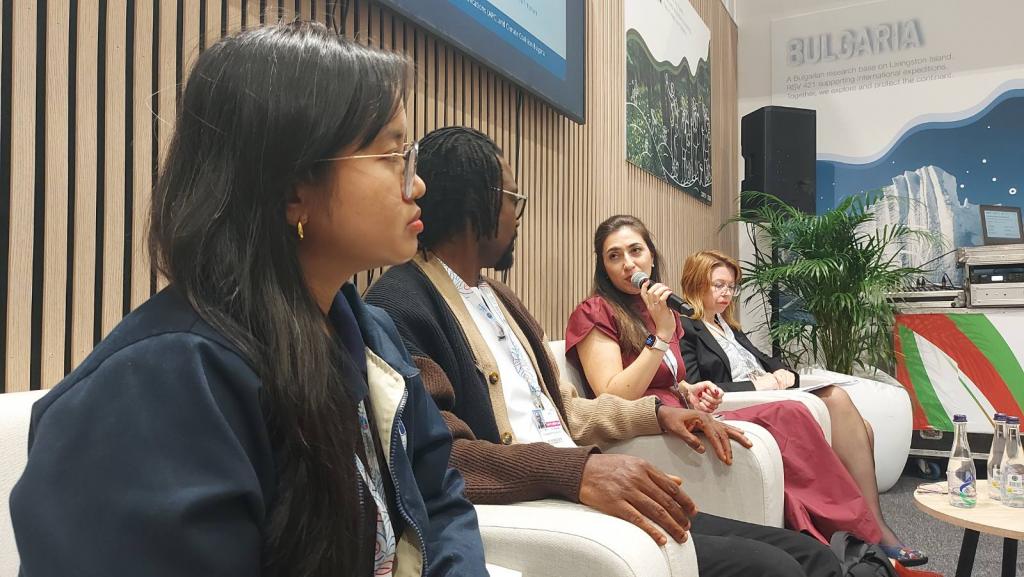
"The lack of accessible and reliable climate data is not merely a technical or administrative deficiency, but also a democratic challenge, undermining the rights to environmental information and public participation guaranteed by the Aarhus Convention," Trifonova (pictured above) pointed out. Her proposals included establishing a publicly accessible, machine-readable national climate damage registry and developing digital maps of heat and flood risks, as well as urban tree cover.
The researcher also raised concerns about algorithm-driven information bubbles, the oversimplification of complex scientific findings and emotionally charged communication on social media. "Young people should be recognised not simply as recipients of climate information, but as active participants in shaping climate policies and as climate defenders whose rights and safety must be protected," was a central message of Trifonova's contribution.
From climate simulations to citizen science
Polina Dikova, Co-founder and Chair of Regenerati, European Climate Pact Ambassador and En-ROADS Climate Ambassador, presented two complementary approaches enabling young people to put science into practice. "Young people can use digital tools to understand climate solutions, collect evidence about environmental challenges in their communities, and turn that evidence into informed climate advocacy," Dikova explained in a summary provided for this article.
The interactive En-ROADS Climate Solutions Simulator, developed by Climate Interactive and MIT Sloan, allows participants to explore how different policies – from energy efficiency and carbon pricing to technological innovation – can influence future emissions and global warming. The simulations also help users understand consequences for health, the economy, ecosystems and infrastructure.
The second approach is citizen science, which connects global climate scenarios with observations of the immediate environment. Dikova shared her experience as an ambassador of the ECHO Soil project, which focuses on monitoring soil health. Through soil sampling kits and practical demonstrations, citizens become involved in collecting information about the condition of soils. According to Dikova, young participants demonstrate particularly high levels of responsibility and enthusiasm.
"En-ROADS helps us understand the global picture by exploring how different policy choices and climate solutions can influence future warming. Citizen science brings climate action closer to home. It enables young people to collect real-world environmental data, document changes in their communities, identify local challenges and contribute evidence that can inform decisions and solutions," Dikova explained.
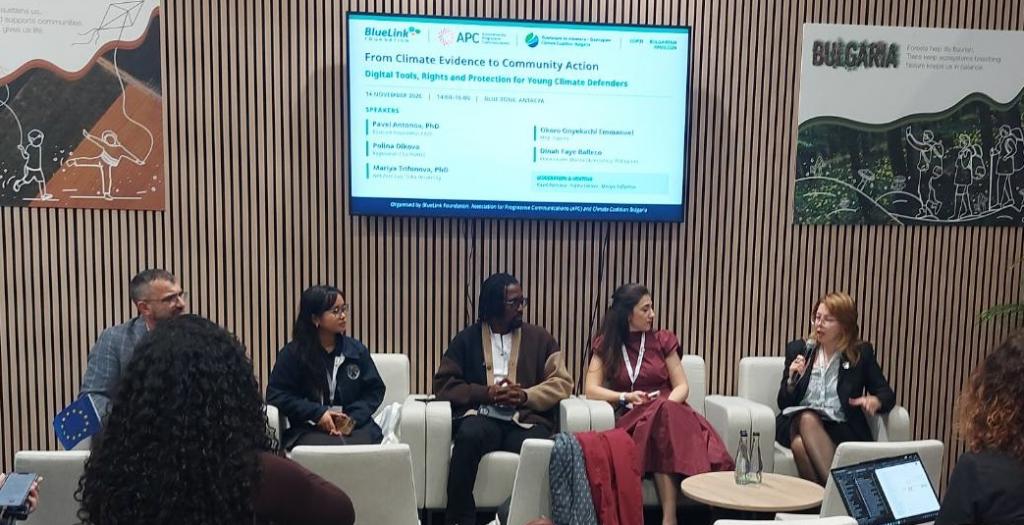
Both approaches transform young people from passive recipients of information into active contributors to scientific knowledge and public decision-making. "We need both global understanding and local evidence. Because climate action starts with knowledge, becomes stronger through evidence, and creates impact through participation," concluded Dikova (pictured on the right below).
The right to participate must go hand in hand with protection
BlueLink's Executive Director and APC Board member, Dr. Pavel Antonov, connected scientific and technological opportunities with citizens' right to influence environmental decisions. He presented findings from the study "Children Participate in Decisions on the Environment and Climate", developed under the European ENRICH project. The analysis highlights the need for more accessible information, appropriate mechanisms for children's participation, and meaningful consideration of their views by public institutions.
Antonov also raised the question of what happens when citizens actually begin exercising their rights – challenging decisions, demanding accountability and defending nature. Preliminary findings from an ongoing BlueLink survey supported by RavniBG indicate that reputational attacks, manipulative information and pressure in the digital environment restrict freedom of civic expression. These observations highlight the need for environmental defenders to receive not only technical security support, but also legal, communications and community assistance.
"The common challenge is not merely to provide opportunities for participation, but to ensure that people can exercise them without fear of intimidation or public discrediting," Antonov emphasised. This discussion builds on the international roundtable on the digital protection of environmental and human rights defenders, held by BlueLink in Sofia on 22 October 2026. Representatives of APC, Bulgarian civil society organisations and experts discussed how online attacks, public discrediting, and legal and administrative pressure can restrict civic participation.
These efforts continue through DiEHaRD – Digital Advocacy for Environmental Human Rights Defenders – a joint initiative of BlueLink and APC aimed at developing practical approaches to collective digital advocacy and protection.
Shared challenges from Nigeria to the Philippines
Okoro Onyekachi Emmanuel, Executive Coordinator of the Media Awareness and Justice Initiative (MAJI) in Nigeria, focused the discussion on the environmental impacts of the oil industry and the role of digital technologies in civic advocacy and accountability.
His contribution examined the use of video, radio and social media to document environmental problems and demand accountability, as well as the barriers faced by communities with insufficient access to digital tools and information.
Among the key issues raised by Emmanuel (pictured on the right below, together with other APC members and partners who participated in the event) was the importance of overcoming inequalities in digital access, which restrict affected communities' participation in both environmental advocacy and economic development.
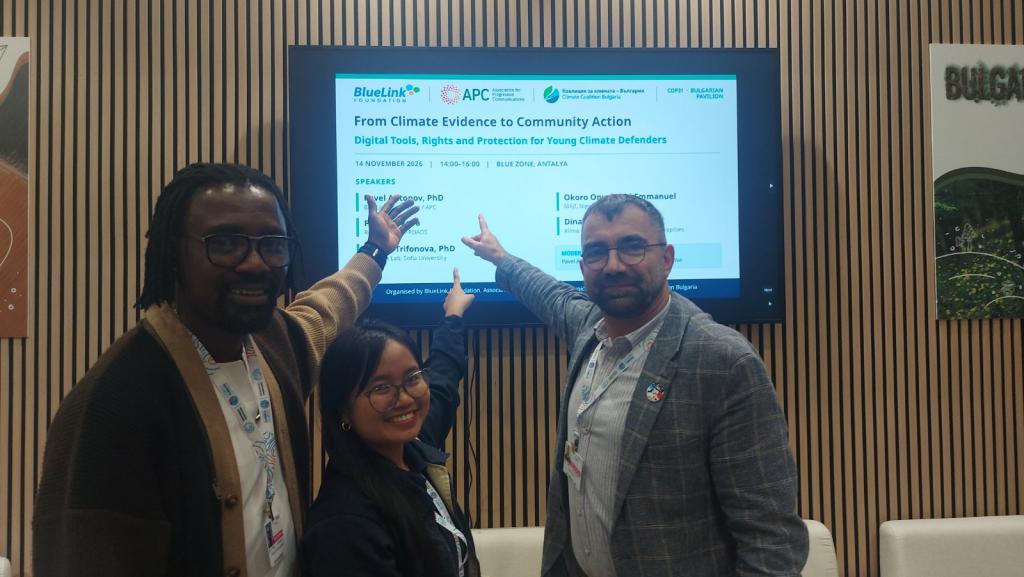
Dinah Faye Balleco (pictured in the centre above), Communications Director of the Klima Center at the Manila Observatory in the Philippines, presented the role of Indigenous Peoples as environmental defenders and responders to climate emergencies. Her contribution drew on the study The Prey of Philippine Red-Tagging, developed in partnership with APC and other organisations and focusing on environmental defenders in the Cordilleras and Mindanao.
The study examines practices of stigmatisation and portraying civic activists as security threats – mechanisms that can obstruct environmental protection and the rights of local communities.
Despite the different social and political contexts, the examples presented highlighted a common problem: access to information and digital technologies alone guarantees neither influence over decisions nor the safety of those who participate.
From international exchange to joint action
The discussion in Antalya demonstrated opportunities for exchanging experience among scientific institutions, civil society organisations and networks defending digital and environmental rights. Bulgarian research and the experiences of partners from Nigeria and the Philippines raised a shared question: how can civic participation move beyond a formal procedure to become a genuine opportunity to influence decisions, supported by reliable evidence and effective protection against pressure?
"Effective climate action requires not only knowledge and technology, but also rights, genuine civic participation and protection for those who take action!" concluded Pavel Antonov. The organisers, BlueLink and APC, will continue their cooperation to bring together scientific knowledge, digital rights, and the protection of environmental and climate defenders.
Further reading
- "Children Participate in Decisions on the Environment and Climate" – BlueLink research
- How Can We Protect One Another Online? – International roundtable on the digital protection of defenders
- National scientific assessment of climate vulnerabilities and impacts in Bulgaria – Net-Zero Lab
- Research on environmental defenders in the Philippines – Manila Observatory
- En-ROADS Climate Solutions Simulator
Organisers and partnerships
The event was organised by BlueLink Foundation and the Association for Progressive Communications (APC). BlueLink has been APC's Bulgarian member since 2000 and is a partner of the European Climate Pact.
The event builds on the work of DiEHaRD – Digital Advocacy for Environmental Human Rights Defenders, which connects environmental and human rights with digital security, solidarity and collective mechanisms for protecting civic defenders.
About BlueLink.net: BlueLink.net is a network for civic thinking and action that supports the strategic use of digital communications by citizens and their organisations to protect the environment, strengthen democracy and defend European values.
 This publication has been prepared within the framework of the BeLIFE project, co-funded by the European Union's LIFE Programme. All publications related to the project are available here.
The views and opinions expressed are solely those of the authors and do not necessarily reflect those of the European Union or the European Climate, Infrastructure and Environment Executive Agency (CINEA). Neither the European Union nor CINEA can be held responsible for them.
 This publication is also co-funded through the DiEHaRD – Digital Advocacy for Environmental Human Rights Defenders project, implemented by BlueLink Foundation with the support of the Association for Progressive Communications (APC). The project strengthens the community of environmental and climate defenders in Bulgaria and develops practical tools for collective digital advocacy, access to information and the protection of environmental rights.
 BlueLink is a partner of the European Climate Pact in Bulgaria.

An event of the Climate Coalition Bulgaria.
Support BlueLink
BlueLink.net is a network for civic thinking and action that supports the strategic use of digital communications by citizens and their organisations to protect the environment, strengthen democracy and defend European values. BlueLink Foundation is a full member of the international Association for Progressive Communications (APC) and supports and coordinates the work of the Climate Coalition Bulgaria.
BlueLink Foundation maintains the network and works in the public interest to promote:
• free access to information and knowledge;
• free and independent media and quality journalism;
• protection of nature, the climate and human rights;
• an active civil society and democratic governance.
If you share our mission and would like to support our independent work, you can make a donation to BlueLink. For further information or other ways to support us, please contact us.

- Влезте или се регистрирайте, за да пращате коментари.


Последно от » Новини
- Environmental defenders’ knowledge is essential to democracy
- Journalists and experts: It’s time for national policies on climate adaptation
- Bulgaria at the Global Greenaccord Forum on Integral Ecology and Journalism in Treviso, Italy
- EU's Fundamental Rights: Citizens' Secret Weapon in Court
- Climate Coalition Bulgaria at CAN Strategy Meeting
- FRA Director: Fundamental Rights Are Key to Tackling Democracy and Climate Crises
- Environmental and Climate defenders in open dialogue with DG Clima in Sofia
- Environmental and climate activists train for legal and media defence
- BNT Launches Weekly Climate Segment Following BlueLink Training
- Bulgaria now has a national goal of climate neutrality by 2050
В действие

Наскоро публикуваха
 |
 |
 |
 |
 |
 |
 |
 |
 |
 |


